
Russell Top 50 Mega Cap Index
The Russell Top 50 Mega Cap Index is a market-capitalization-weighted index of the 50 largest stocks in the broad-based Russell 3000 universe of U.S.-based equities. All Russell U.S. Indexes are subsets of the Russell 3000 Index, which includes the well-known large-cap Russell 1000 Index and small cap Russell 2000 Index. The index is reconstituted annually to account for new and growing member companies. The Russell Top 50 Mega Cap Index typically pays an above-average dividend yield, a reflection of the general safety and cash flow generation found among the largest traded companies. Nasdaq’s website ran a Zacks.com-reported story in June 2018 headlined “4 Solid Reasons to Buy Mega-Cap ETFs Now.” The Russell Top 50 Mega Cap Index is a market-capitalization-weighted index of the 50 largest stocks in the broad-based Russell 3000 universe of U.S.-based equities. The Russell Top 50 Mega Cap Index is a market capitalization weighted index of the 50 largest stocks in the Russell 3000 universe of U.S.-based equities.
What Is the Russell Top 50 Mega Cap Index?
The Russell Top 50 Mega Cap Index is a market-capitalization-weighted index of the 50 largest stocks in the broad-based Russell 3000 universe of U.S.-based equities. The Top 50 index therefore is a mega-cap index, and may be compared with the Dow Jones Industrial Average (DJIA), which contains 30 blue chip stocks.
Understanding the Russell Top 50 Mega Cap Index
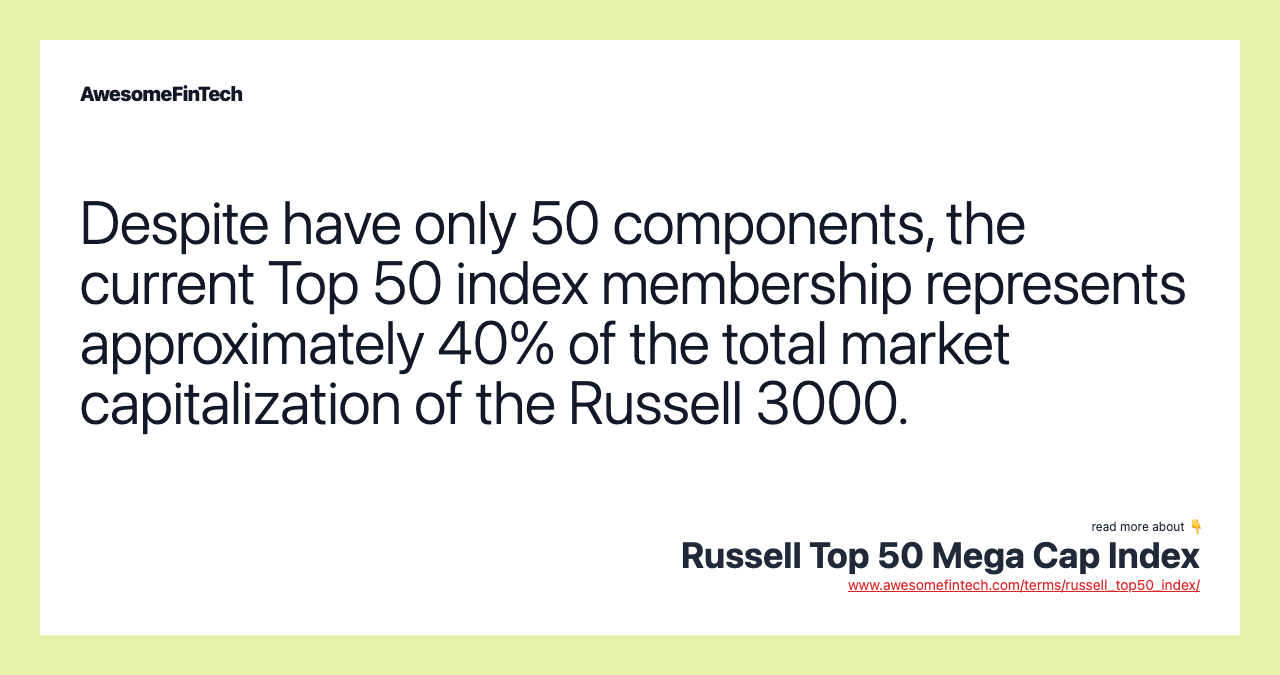
The Russell Top 50 Mega Cap Index holds just 50 stocks, but because modern mega cap companies are so large, it still represents a large proportion of all U.S. equities. Russell U.S. Indexes are the leading U.S. equity benchmarks for institutional investors. This broad range of U.S. indexes allow investors to track current and historical market performance by specific size, investment style and other market characteristics.
All Russell U.S. Indexes are subsets of the Russell 3000 Index, which includes the well-known large-cap Russell 1000 Index and small cap Russell 2000 Index. The Russell U.S. Indexes are designed as the building blocks of a broad range of financial products, such as index tracking funds, derivatives and Exchange Traded Funds (ETFs), as well as fulfilling their role as performance benchmarks. The index can be considered a representation of mega-cap stocks, as the average member's market cap is more than $175 billion. The index is reconstituted annually to account for new and growing member companies.
The Russell Top 50 Mega Cap Index typically pays an above-average dividend yield, a reflection of the general safety and cash flow generation found among the largest traded companies.
Mega-Cap ETFs on the Russell Top 50 Index
Nasdaq’s website ran a Zacks.com-reported story in June 2018 headlined “4 Solid Reasons to Buy Mega-Cap ETFs Now.” Mega-cap generally describes companies with a market capitalization above $300 billion. An ETF, or exchange-traded fund, typically invests in a security tracking an index, an index fund, bonds, or a commodity.
The article analyzed data based in part on the Russell 2000 Index, saying that though small-cap stocks led in the first half of the year from February to May, June is set to bring a rise in mega-caps.
The article lists its top four recommendations for investors when looking to mega-cap ETFs:
Related terms:
Benchmark
A benchmark is a standard against which the performance of a security, mutual fund or investment manager can be measured. read more
Blue Chip
A blue chip is a nationally recognized, well-established, and financially sound company. read more
Dividend Yield
The dividend yield is a financial ratio that shows how much a company pays out in dividends each year relative to its stock price. read more
Dow Jones Industrial Average (DJIA)
The Dow Jones Industrial Average (DJIA) is a popular stock market index that tracks 30 U.S. blue-chip stocks. read more
Index Fund
An index fund is a pooled investment vehicle that passively seeks to replicate the returns of some market indexes. read more
Mega Cap
Mega cap is a designation for the largest companies in the entire investment universe as measured by market capitalization. read more
Russell 2500 Index
The Russell 2500 Index is a market-cap-weighted equity index that includes 2,500 mid-cap and large-cap stocks all under a market cap of $10 billion. read more
Russell Top 200 Index
The Russell Top 200 Index is a market capitalization weighted index of the 200 largest companies in the Russell 3000 index. read more
Russell 2000 Index
The Russell 2000 index measures the performance of the 2,000 smaller stocks that are listed in the Russell 3000 Index. read more
Russell 1000 Index
The Russell 1000 Index, a subset of the Russell 3000 Index, represents the 1000 top companies by market capitalization in the Unites States. read more